Timelines

Migration is a natural part of living systems, and human history is no exception. Yet it remains one of the most debated public issues of our time.

Both people and borders move. Who is allowed to move, and who is granted rights, lies at the heart of how nations define belonging. In Germany and the United States alike, these debates have been deeply intertwined with evolving ideas of race and ethnicity.

These timelines trace how citizenship and belonging have been constructed, challenged, and redefined through laws, social movements, global events, and cultural works — and how those histories continue to shape the present.

Close
1942
-
1964
Mexican “Guest Worker” Program Established

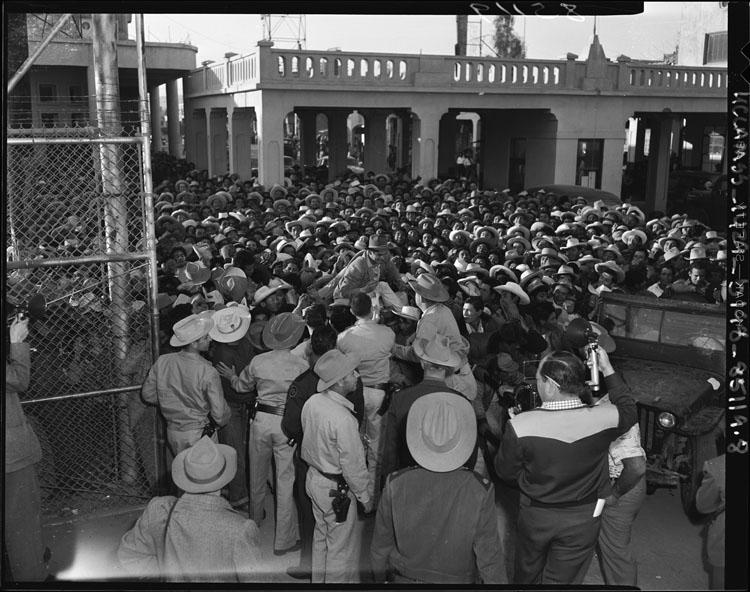
In 1942, the United States and Mexico created the Bracero Program, facilitating low-paying temporary Mexican laborers to work in the southern United States. The “guest worker” program was popular in the agriculture industry and remained in place until 1964.

In total, more than five million Mexicans entered the United States as braceros, a Spanish word that loosely translates to mean someone who works as a field hand. Labor and human rights abuses abounded under this program. Before being allowed to cross the border, workers were stripped, examined, and sprayed with “white powder,” also known as DDT, to kill lice. Once across the border, many were forced to live in camps, work seven days a week during harvest season, and forgo pay during slow months. Exploitive conditions also led to Bracero activism, most notably in the Northwest. The United Farm Workers labor union rose to prominence shortly after the end of the Bracero program in 1966, under the leadership of César Chávez, Gilbert Padilla and Dolores Huerta.
Mexican Workers Awaiting Transport to Farm Work in Mexicali. Immigrant History
Mexican Workers Awaiting Transport to Farm Work in Mexicali.
United States
Sources
  1. THE BRACEROS: An untold story. Date accessed: June 16, 2015.
  2. Francine Gair. Braceros: History, Compensation. Inside Chico State. Edition 12, no. 2. Date accessed: June 16, 2015.
Additional Resources
  1. “Why Braceros? – Council of California Growers”. Date accessed: June 16, 2015.
  2. Bracero History Archive. Date accessed: June 16, 2015.
  3. Kitty Calavita. Inside the state: the bracero program, immigration, and the I.N.S.. New York: Routledge.
  4. George Sanchez. Becoming Mexican American: Ethnicity, Culture, and Identity in Chicano Los Angeles, 1900-1945. New York: Oxford University Press.
Learn how these timelines were made
UNITED STATES
/
GERMANY
All Events
Stories: 0
Search icon
Instagram WRInstagram From HereFacebook
Copyright 2026 With Wings and Roots. All rights reserved.
Terms and Conditions