Timelines

Migration is a natural part of living systems, and human history is no exception. Yet it remains one of the most debated public issues of our time.

Both people and borders move. Who is allowed to move, and who is granted rights, lies at the heart of how nations define belonging. In Germany and the United States alike, these debates have been deeply intertwined with evolving ideas of race and ethnicity.

These timelines trace how citizenship and belonging have been constructed, challenged, and redefined through laws, social movements, global events, and cultural works — and how those histories continue to shape the present.

Close
1914
-
1918
World War I Spurs Anti-German Crusade

During the time of World War I, the U.S. witnessed drastic decline in immigration and a rise in intolerance toward foreigners. As Germany was a U.S. enemy during the war, German immigrants and German Americans found themselves the targets of forced Americanization campaigns and daily hostility and discrimination. The use of German language in schools (see also: State legislation authorizes German bilingual education, 1831)and the wider culture came under attack. In some places, German music was even banned. By the close of the war, most states had passed laws against foreign language instruction. Many German Americans were compelled to prove their allegiance to the United States through military service and cultural assimilation.
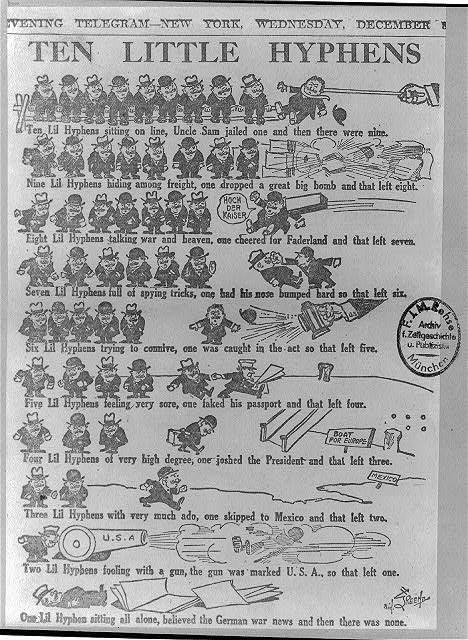
Newspaper Cartoon Clipping from New York Evening Standard. 1915. Library of Congress
Newspaper Cartoon Clipping from New York Evening Standard. 1915.
With Anti-German sentiments rising in America due to World War I, campaigns and propaganda against German identity and culture began to circulate in the U.S. One of these pervasive ideas from the Anti-German crusades was getting rid of "hyphenated Americans". President Woodrow Wilson spoke upon this as people who have not truly become Americans due to their loyalty to their countries of origin. The cartoon seen above echoes this sentiment with it depicting ten cartoonish Germans who slowly die off due to their allegiance to their German identity. This anti-hyphenation is one of the many phenomena that contributed to the modern-day notion of Whiteness we know today.
United States
Sources
  1. Eric Foner. Give Me Liberty! An American History. Edition Seagull Third ed. New York: W.W. Norton.
Additional Resources
  1. Gary Gerstle. “Liberty, Coercion, and the Making of Americans”. The Journal of American History. Edition 84, no. 2. Pages 524-558.
  2. T. G. Wiley. “The imposition of World War I era English-only policies and the fate of German in North America”. Language and politics in the United States and Canada. Mahwah, NJ: Erlbaum.
Learn how these timelines were made
UNITED STATES
/
GERMANY
All Events
Stories: 0
Search icon
Instagram WRInstagram From HereFacebook
Copyright 2026 With Wings and Roots. All rights reserved.
Terms and Conditions